
Publishing random blog posts rarely moves the needle. You write, hit publish, and a month later the post has a handful of visits. You are not alone.
An Ahrefs study of about 14 billion pages found that 96.55% of pages get no traffic from Google at all. Topic clusters fix this by organizing your content so search engines, and AI tools, see your site as the authority on the subjects that matter to your business.
Key takeaways
- A cluster is one pillar page linked to several in-depth supporting articles.
- Pick 3 to 5 topics tied directly to the services you sell.
- Build your question list from real customers, not just keyword tools.
- Link in both directions and measure performance at the cluster level.
What a topic cluster is
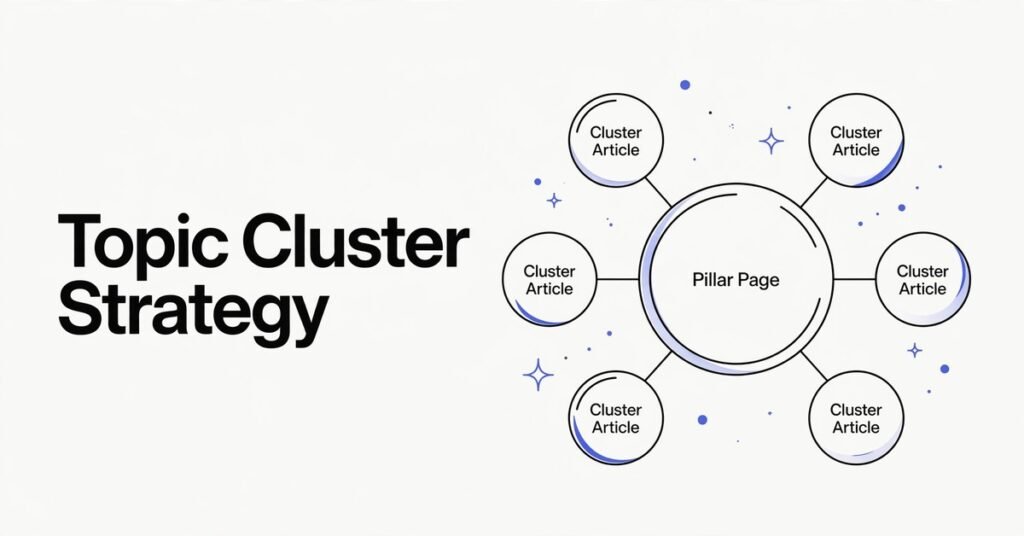
A cluster is one comprehensive pillar page on a broad topic, for example “Local SEO for dentists,” linked to several supporting articles that each cover a specific subtopic in depth, with links in both directions. Together they show search engines depth, not just one lucky page.
| Pillar page | Cluster article | |
|---|---|---|
| Scope | Broad overview of the whole topic | One specific question or subtopic |
| Length | Long and comprehensive | Focused and detailed |
| Links | Out to every cluster article | Back to the pillar and related articles |
| Example | Local SEO for dentists | How dentists can get more Google reviews |
Step 1: Pick 3 to 5 core topics
Choose topics tied directly to the services you sell and the problems your customers have. Each should be broad enough for a pillar and narrow enough to own. “Marketing” is too broad; “Google Ads for home service businesses” is a topic you can win.
Prioritize topics by business value first and search volume second. A topic with modest search demand that maps directly to your most profitable service will usually earn more revenue than a popular topic you cannot sell into.
Step 2: Map the questions
List every question customers ask about each topic, using sales calls, reviews, support emails, Google’s “People also ask” box and keyword tools. Tools like AnswerThePublic and Google Search Console reveal the exact wording people use. Group the questions into subtopics; each group becomes one supporting article.
Pro tip: Ask your front desk or sales team to write down every question they hear for two weeks. It is the most accurate keyword research you will ever do.
Step 3: Build the pillar page
Write a thorough overview that briefly answers each subtopic in a short, answer-first paragraph and links out to the detailed articles. Add a table of contents, clear headings and visuals. Aim to make it the best single page on the topic, the page you would send a new customer to first.
Keep the pillar focused on helping, not selling. Add a short, relevant call to action near the end, such as booking a consultation or downloading a checklist, so the traffic it earns can turn into leads.
Step 4: Publish supporting articles
Write one focused article per subtopic. Each should link back to the pillar with descriptive anchor text and link to closely related articles in the same cluster. This is also the structure AI tools reward, as we explain in our AI search guide.
Example in action: HubSpot is a well-known public example. Around 2017 it reorganized its blog around pillar pages and topic clusters, and its write-up on topic clusters helped popularize the model. For a small business, the same idea at smaller scale works: a Phoenix HVAC company might build one pillar on “AC repair” and eight articles on questions like “Why is my AC blowing warm air?”
Step 5: Maintain and expand
- Refresh pillar pages at least twice a year with new data and examples.
- Add new articles as new customer questions appear.
- Earn a few quality backlinks to the pillar; Ahrefs’ data shows how rarely pages rank without them.
- Track rankings, traffic and conversions at the cluster level, not just per post.
Your topic cluster starter plan
Tick each item as you complete it.
The bottom line
Clusters turn a blog into a system. A few well-built clusters will outperform dozens of disconnected posts, and the depth they create supports every other channel, from local SEO to paid ads and social content.
Keep reading
Frequently asked questions
What is a topic cluster in SEO?
A group of related content made up of one broad pillar page and several detailed articles on subtopics, all interlinked so search engines recognize your depth on the topic.
How many articles should a topic cluster have?
Most clusters start with 6 to 10 supporting articles. Add more as new customer questions appear.
How long should a pillar page be?
Long enough to cover every subtopic briefly and link out to details, often 2,000 words or more, but clarity matters more than length.
Do topic clusters help with AI search?
Yes. Deep, well-organized content with clear answers makes your site a stronger candidate for citation in Google AI Overviews and tools like ChatGPT.
How long before topic clusters show results?
Most businesses see early movement in two to three months and stronger results in six to twelve months, depending on competition and publishing consistency.
Want content that ranks and brings in leads?
Get a free content audit and a 90-day topic cluster plan for your niche.
Get my free auditOr explore our content marketing service.Browse more topics: Content Marketing · eCommerce · Local SEO · PPC · SEO · Social Media

Olivia Johnson has over nine years of experience in technical content writing, specializing in creating clear, accurate, and engaging content for technical and business audiences. Her experience enables her to translate complex technical concepts into accessible content while maintaining accuracy and depth. She focuses on developing well-researched content that supports user understanding, search visibility, and broader business objectives.